Showing posts with label Outside Zone. Show all posts

Saturday, September 21, 2024

The Quarterback Dilemma

One of the biggest mistakes I made as an OC that I see offensive coordinators make is their personnel at the quarterback position. You get to put 11 guys on the field, and you need to put your best 11 on the field. Too often we get caught up thinking we have to play a "quarterback" at the quarterback position. If your quarterback is not one of your best 11, then he does not need to be on the field. 

If you have a kid playing quarterback that doesn't throw well or run well and doesn't put any pressure on the defense, you need to evaluate if he gives you the best chance to win. We have all had quarterbacks who were great leaders that maybe didn't throw well or run well, but your team was it its best when they were on the field. 

But if you have a kid on the field that doesn't run well or throw well, and the defense doesn't have to account for him, then you might need to look at playing a different kid. Then you need to adjust your system to fit your best guys being on the field. 

Adapt To The Skillset 

If you are an air raid team and you don't have a quarterback that can execute air raid concepts, you have two choices. Put a kid at QB who can execute those concepts, or put one of your best 11 at the quarterback position and build your offense to their skill set. The same is true for any offensive system you might run. Great offensive coordinators are able to find a way to get their best 11 on the field where they can capitalize on their skillset. Adapt your play calling to the strengths and skills of the guy taking the snaps. 

QB Touches The Ball Every Snap

Your quarterback is the only player who is going to touch the ball every single play. If you have a kid who can do dynamic things, then it is okay to snap him the ball. I understand that not every kid is capable mentally of the responsibility of communicating the play and taking a snap. But if you are struggling on offense and your QB is putting any sort of pressure on the defense, you might consider changing who is taking the snap every play. 

Who gives you the best chance to win the football game? Who is the guy you can put at quarterback that can increase your production numbers? 

It might be that you don't have a quarterback who gives you the best chance to win, or it might be that your starter is injured. Your backup may be a great kid, but does he give you the best chance to win? 

We went through this a couple of times in my career. We had a kid who had come through our system as a QB. He spot played as a 10th grader, and then was ready to take the starting job as a junior. He worked hard and did everything right. Three games into the season we were struggling to score points. We were doing our self-scout analysis and realized we had most of our explosive and productive plays when we were in our wildcat personnel. We went back and watched all of our first three games and looked at the data. The data said we were averaging 4.4 yards per play with our QB taking the snap, and 8.2 yards a play when our "wildcat" was taking the snap. 

We made a decision to retool our offense to give our wildcat the majority of the snaps. We already were a read based offense that had elements of misdirection. We decided to do more of that with a better athlete taking the snap. He had a decent arm, but he was not going to be able to throw us down the field making progression reads. We set up our pass game with more "him" balls. A him ball is where I tell the QB to throw to "him," or a specific player. That took pressure off the QB. 

Building Concepts 

We ran inside zone, outside zone, counter, and power. We built our concepts to play off each other as a series. We ran outside with the back in a sidecar position. To complement this, we ran counter off of outside zone action with the QB carrying the ball. This was simple for our guys to execute, but stressed the defense. Below is our QB counter concept. 

The QB is going to ride the back as the back accelerates through the mesh. The QB is going to pull the football get downhill. The guard is pulling to kick, and the Y or H back is going to wrap to the PSLB. This is a very simple concept. We can also wrap the guard and kick with the Y. The linebackers cannot fly on flow as they must read the guard. 

We then built a boot concept as a play action component off the QB counter. When the safeties added themselves to the box, we were able to take advantage of space. The blocking looked the same, with the BSG pulling to account for the unblocked edge player. The QB is going to sell the OS Zone fake to the back, take one step as if he is pulling to run counter, then gain depth and width. 

He was going to have a two man read, looking at the flat first, then the crosser. The key was the timing of the routes and the QB understanding the timing. If the QB does not have the flat or the crosser, run. 

If you have a kid who can run the ball well that can take snaps, it puts a lot of pressure on the defense. Even if he doesn't throw particularly well, you can build concepts into your pass game that simplify things. We used sprint out and boot concepts where he had a simple high-low read. If the read wasn't there, he could run. We would throw fast screens as an extension of the run game, and would throw hitches and verticals.

The big thing I want to get you to think about is simple. Do we have our best 11 on the field? Are we married to a system, or are we married to production? 

This is just a small example of a simple way to put together a series. There was more too this, but this is how it started. As you begin to look at what you are doing and put together a package for a more dynamic player, build off what your kids already know. Take that prior knowledge and build a simple series of plays that complement each other. 

Importance of Preparation

One of the biggest parts of our success was our preparation. You have to do a great job of game planning for your opponents which will greatly improve your play calling ability. If you want to be more prepared each week, I highly recommend you check out my game and practice planning resource. I spent much of my career as a coordinator. I was an offensive coordinator and defensive coordinator, and coached at both the high school and college levels. I have made available all of our game and practice planning resources that helped us win more games. These have everything you need to be more prepared. They are editable and customizable, and are available as an instant download.  https://sellfy.com/p/AndN/ 

It includes everything from a scouting report template, to weekly practice plans and scripts, to a two-sided color call sheet, and more! Each of the nine documents are fully editable and customizable! Order today and start preparing for your first game right now! This helped us be able to be prepared to attack the defense and put more points on the board. It also helped us be much more efficient and targeted on the weekends when we were game planning. 

Tuesday, December 29, 2020

Teaching the Running Back to Read 1 to 2 on Outside Zone

The outside zone play is a versatile concept that gives you the opportunity to attack multiple gaps of the defense using a wide angle. We want to be able to create vertical seams in the defense through horizontal movement. Our ultimate goal with the outside zone play is to get the ball to the perimeter. Once you establish that you can get the ball on then edge, you can get the defense flowing. This creates opportunities for the back to get north and south before getting to the edge. 

When I talk about outside zone at clinics, I get a lot of questions asking how we coach the running backs. Coaching the back is a vital component of having success with the outside zone. The back must understand his aiming point, the angle of his pads, the timing, and where his eyes should be. He has to know when to put his outside foot in the ground to get vertical, and he has to know when to take the edge. Our running backs coach at Estacado, Alfonzo Franklin, does an outstanding job of teaching our backs the proper vision points. 

When we installed outside zone in 2000, we told the back to run to daylight. Our backs with speed would race to the edge and usually win. What we found, however, was that we missed opportunities for explosive plays when we didn't get the box locked. What we mean by getting the box locked, is that the offensive line gets leverage on the defenders by getting to their outside bicep, essentially locking them inside. We made an adjustment to how we coached our backs, and it made all the difference. Once we made this adjustment, we increased our per play average on outside zone from 6.4 yards per play to 8.2 yards per play. 

Running Aiming Point

When we are under center or in the pistol meshing playside, the running back's aiming point is the outside leg of the tackle. We had the exact same aiming point on inside and outside zone. The back takes a zone step playside, comes to balance, and works to the outside leg of the playside tackle. 

 
If the back is in a sidecar position, he is going to be fast and flat, attacking the edge. We want him to accelerate across the toes of the quarterback, through the mesh. We tell him to take three steps through the mesh and three steps to decision. 

The path of the back is very important on all runs, but it is particularly important on our outside zone play. 

Coaching The Running Back's Eyes

The change we made was having our running back read what we called "1 to 2." This will determine whether the back was going to hit the edge, or hit downhill. And if he hit the play downhill, it made him always be right when he hit downhill. This gave them a definitive place to put their eyes, and helped us to have more consistent play. 

We identify the number 1 as the widest first level defender. The number 2 is the next first level defender inside the number 1. 

In the figure above, we are running outside zone to the right. The walked up outside linebacker is on the line. He is the number 1. The defensive end is the number 2. The running back must identify and know that he is reading one to two. 

In the figure above the defense is in a 4-2 look, with the defensive end in a 9 technique. He becomes number 1, and the defensive tackle is number 2. 

In the figure above, the offense is running inside zone to the left, away from the tight end. The defensive end is number 1, and the defensive tackle is number 2. Our rules for #1 to #2 were adaptable whether we ran the play to the tight end, or away from the tight end. This helped to simplify things for our running backs, regardless of what formation we were running our outside zone play from. 

Once the running back understands who number 1 and number 2 are, he can learn what he is reading. It is vital he has his eyes in the right place. We want him to have his eyes going from 1 to 2. We drill this into the running backs every day. His rules are simple:
  • If 1 is in, I'm Out.
  • If 1 is out, I'm In, My Eyes Go to 2. 
  • If 2 is in, I'm Out.
  • If 2 is out, I'm In.
As the back attacks, his aiming point, he is going to put his eyes on number 1. If number one is in, meaning we get him reached, the back is going to accelerate to the edge. He knows he is running outside. This is the easiest read for the running back. 

When we teach the running backs, the first thing we teach them is 1 being in. To create creases, we must force the defense to flow. We want them to know that we can take the edge, and force them to run. When they run, they create creases. 

Below is a video clip of #1 being in and the back hitting the edge. 
The tight end gets to the outside of the OLB who is number 1, and that gives the running back the edge. 

Below is another clip of #1 being in. The TE gets to the outside bicep of the OLB, creating an opportunity to get the running back to the edge. 
We want to use our outside zone play to get to the edge. When we can get our athletes on the perimeter, we will have more big play opportunities. 

What happens when #1 goes out? Is the play dead? That is what happened to us when we first installed the outside zone. We didn't give the back an option to put his foot in the ground and get vertical. We told him to win to the edge. Once we made an adjustment when #1 was stretching the play, we became more explosive. At one point we had worked on installing mid-zone, but with our #1 to #2 read on outside zone, we essentially gained the benefits of mid-zone without having to invest in the installation. 

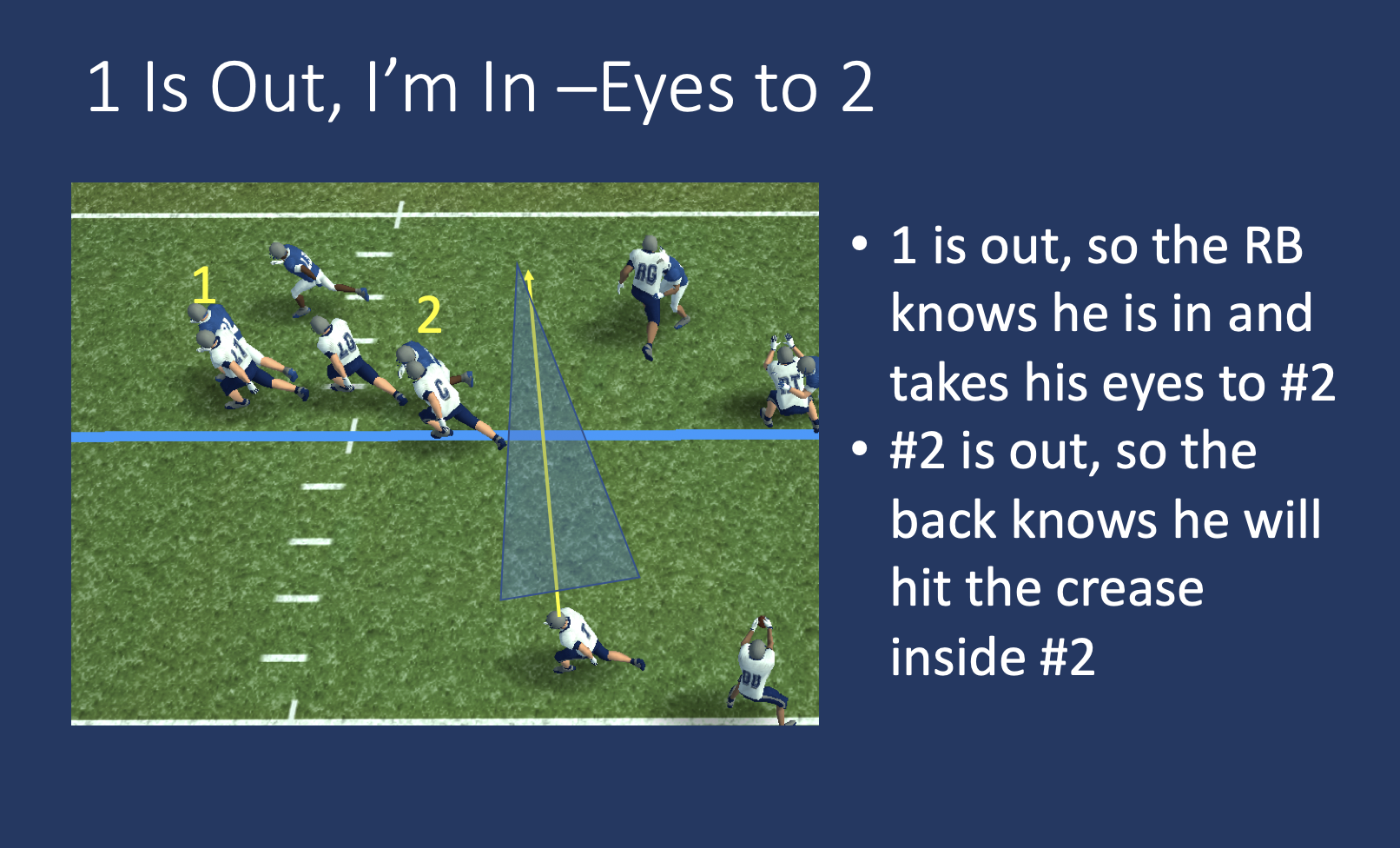
When #1 is out, the running back gets his eyes to #2. The back knows he doesn't have the edge, and #2 will show him where the vertical crease will be. If #2 is out, the back will go inside of #2. If #2 is in, the back will go outside of #2. 

The back sees #1 is out, so he takes his eyes to #2. He sees #2 is out, so he hits downhill inside #2. The flow of the defense has created a crease where the play hits downhill. The play is hitting in the A gap, but the A gap is where the C gap was located presnap. It looks like the play hit hard downhill, but that is because of the horizontal displacement of the defense. 

Below is a video clip illustrating #1 being out and #2 being out. 
You can see, this creates a crease to hit downhill. The defense is flowing to take away the perimeter, and they are giving the offense a crease inside. This all is predicated with creating flow. 

Below is another clip of #1 and #2 being out. 
And one more...
And another...

As you can see, the defense is flowing fast to take away the wide action. This creates seams for the running back. 

Let's look at the next read. If #1 is Out, and the back takes his eyes to #2 and sees #2 in, the back will hit between #1 and #2. This often happen against under front defenses when we can the 1 technique reached, and against odd defenses with a 0 nose guard. 
The figure above illustrates when #1 is out and #2 is in. This gives us a crease between #1 and
#2. 

Below is a video example of #1 being out and #2 being in. When #1 is out and #2 is in, the back hits downhill between 1 and 2. 
Here is another clip with 1 out and 2 in. This is from a trips look where we have the #3 receiver working inside to account for the playside inside backer. This is a wrinkle that is good from 3x1 sets where #3 is uncovered. 
Here is another clip of #1 being out and #2 being in. This time it is to a 3 man surface. 

You can see from the video above that the read for the back allows you to add versatility to the outside zone play. You stress the defense, and force them to slow down their ability to flow to the edge. Anytime you can make defenders play slower, you are going to have more explosive plays. 

Whether you are man or zone blocking, the back must be able to force the defense to defend the edge. Once he forces them to defend the edge, the back can use his vision to find the crease when the edge player widens to take away the perimeter. Teaching your young running backs to read 1 to 2 will help them be able to better find the crease, and will help you to be more successful running this concept. It also will give them more concrete and specific coaching than simply saying run to daylight. 

I wish you the best as you prepare for the upcoming season. If you are looking for some resources that will help you in your preparation, I have put together some things that coaches at all level of football are using with their programs. Not only will these help you be more organized, they will save you valuable time on the weekends. 

A few years ago I was speaking at a clinic about our game planning and an FBS coordinator asked me after the talk to go through what we do. I shared with him our offensive game planning resource and he used it through the spring. He emailed me back that it was a game changer. It was an honor to have him use these documents. After speaking at clinics and hearing that more coaches didn't know where to start, I decided to make these available.

Here is a link to my offensive game planning documents: https://sellfy.com/p/AndN/ 
It includes everything from a scouting report template, to practice plans, to a two-sided color call sheet, and more! Each of the nine documents are fully editable and customizable! Order today and start preparing for your first game right now! At one time this was $99, but it is available right now for less than $13!
Here are a couple of screen shots to show you what our call sheet looks like: 

This shows you a small portion of it. It is a fully editable, customizable two sided call sheet. It gives you the ability to better organize and be prepared on game day. It helped us to be better play callers on game day. There are eight other fully customizable documents! Some of the top high school programs in the country use this, as do several college programs!

When I was a defensive coordinator we adapted this to our defensive preparation! 
Here is a link to the defensive game planning documents. It includes 12 fully editable and customizable documents. https://sellfy.com/p/AY1u/ These are what we used to post 6 shutouts when I was a defensive coordinator. Defensive coordinators at all levels of football are using this. Again, it is less than $13 right now!

And finally, I put together a special teams resource. This has everything you need, included drill tape, practice tape, and game footage. It includes teaching presentations and scouting forms just for special teams! https://sellfy.com/p/tJwz/ This helped us to build dominating special teams! 

I wanted these to be available at a very reasonable cost. These can help you to be more successful on the field and more efficient in the office! 

 Last year I got hooked up with CoachTube, and put together three courses for offensive football coaches. I put together two courses on RPO's, and a course on Building An Elite System of Communication. All of these courses will help you to score more points! 

https://coachtube.com/users/coachvint


All three of these courses are detailed, with everything you need to be more explosive and to score more points. 

The course on communication gives you a detailed approach to your gameday communication. I give you a system and a process to improve the quality of conversations, leading to improved play calling on game day. This course has received outstanding reviews from coaches at all level of football. A coach with multiple state titles told me this course helped them to be much more efficient and explosive this season. 

My two RPO courses take you through a systematic process of installing RPO's into your offensive system. RPO's put the defense in conflict, forcing them to defend all 53 yards of width and all 6 skill players every single play. I not only give you a system, but I teach you the methods to develop your own RPO concepts. 

https://coachtube.com/users/coachvint

New Book

Over the last several months, I have stepped out of my comfort zone and wrote a new book about faith and purpose. The book is available as a paperback on Amazon, and as an eBook for the Kindle App. The cool thing about the Kindle app is that you can read the book on any device. I invite you to read it, and discover the power you receive when you make a decision to walk with the Lord. Here is a link to the book: Finding Faith

Since publishing the book, I have received numerous texts, calls, and emails, from people who are going through similar trials and tribulations. They were feeling many of the same things I was feeling. The found comfort in the book. They also found they had a desire to change and to live better. They wanted more joy. 

I would invite you to read the book and discover the possibilities that God has planned for your life.