Sunday, January 10, 2021

Teaching Tackling in Three Phases

When I was hired to be a defensive coordinator and took over a struggling defense 15 years ago, one area we had to fix was our tackling. Along with building a system of tackling accountability I wrote about in a previous post, we also had to teach our guys to get the ball carrier to the ground. We made a decision to teach tackling in three phases. 

1. Pre-Contact Phase

2. Contact Phase

3. Post-Contact Phase

Before I get into the three phases, I want you to understand why we emphasized tackling. The year before I took over we had given up nearly 40 points per game. The biggest issue was bad tackling. Think about your own defense. Is there anything more frustrating than missed tackles? Everyone does their job, you have a tackler in place, and he misses the tackle. We did not want to miss tackles and give up yards after contact. We simplified what we were doing on defense, allowing us to focus on fundamentals. We focused on the Three T's: Technique, Tackling, and Takeaways. 

Teaching Tackling 

Contact Phase

We started teaching tackling first by teaching the contact phase first. We wanted our players to know how to properly contact a ball carrier as this would better help them how to get into position to make contact. We put the players partnered up down the 30, 35, and 40 yard lines on two knees. They would drop their hips, and load their hands. We would give the command, "ready, set" to get them into this position. The figure below shows how the players would be set up on grids. We would have then lined up sideline to sideline, with coaches stationed intermittently spaced. 

Next, we would teach them how to make contact. They would get knee to knee facing each other, half shaded. They would both be on their knees. The first drill was called Hips and Hands. We would say "ready" and they would load their hands and sit back slightly. Then we would say hit. They would shoot their hips and hands. We wanted their hips to explode up and forward, and their hands to shoot through the sides of the offensive player. We wanted the tackler's elbows tight to the body. We constantly repeated "eyes up" on each tackle. We wanted the hands to shoot vertical, not "around" the ball carrier. 

When they shot their hips, we coached them on how they contact the ball carrier with their upper body. Contact was made with the front of the shoulder pad. We wanted their eyes up through the tackle. We wanted them to contact the ball carrier with the front of the breast plate. We didn't want them to contact with the arms, or with the top of the shoulder pad. When they contact with the arms they are going to lose the tackle, and give up yards after contact. When they contact with the top of the shoulder pad, the head drops down. This is a safety issue. We wanted the eyes up. Our goal was to contact the hip of the ball carrier with the front of our shoulder pad. This meant we had to have good knee bend. 

The next drill was called squeeze. We would say ready, and the tackler would load their hands. We would say hit, and they should shoot their hands and hips forward and up, and we would then say squeeze. We wanted them to grab the back of the shoulder pads and squeeze. We wanted to pull the ball carrier to us and squeeze him tight. 

We would work these drills alternating contacting with the left breast plate and right breast plate. We wanted to make sure we stayed square, and kept our eyes up.

Once we felt comfortable teaching the contact phase from our knees, we would stand up. We had the ball carrier and the defender 2 yards apart. On the command load, the tackler would load his hands and begin to shimmy his feet. He was moving them quickly, closing space on the ball carrier. Once he was about to step on the ball carriers toes, he would shoot his hands and hips. He would contact with the breast plate, and squeeze the ball carrier. 

We would make sure we alternated contacting with each breast plate. with our eyes up. We wanted them to be confident tacklers, regardless of which side the ball carrier was on. We wanted to get a minimum of 10 really good reps for both people before we progressed to anything else. We wanted them to be thick on contact, meaning we wanted them to contact with their inside number on outside number of the ball carrier. If you are thick on a tackle, you are going to generate more force. If you are thin on a tackle, you generate less force. You also tend to fall off the tackle. 

Once we felt comfortable with the contact phase, we progressed to the post contact phase. Everything we did was about control, and breaking the tackle into small parts. 

Post-Contact Phase

What happens after you make contact is very important for completing the tackle with the minimum amount of yards gained. We had three coaching points. First, we wanted to get square after contact. You aren't always going to be able to square up a ball carrier before contact. Once contact was made, we wanted to work to a square position. This made it harder for the ball carrier to drag us for extra yards. Second, we wanted to run our feet. We we wanted drive the ball carrier backwards. Third, we wanted to bring our hips. Bringing our hips helped us to get him to the ground. This was important to completing the tackle. While we brought our hips on contact, the hips tended to fall back after contact. Emphasizing bringing the hips through the contact phase into the post-contact phase, helped us to secure the tackle and drive the ball carrier backwards. 

We would do a drill called run your feet. We would fit up on the tackle, already square. On the command run, the tackler would run the ball carrier backwards. During this phase we emphasized bringing your hips. While we want them to bring their hips on contact, we must have them keep their hips on as the ran their feet. Many missed tackles happen because the hips are back. We wanted them to bring their hips through the entire post-contact phase. 

Next, we would progress to a drill called Get Square and Run. This is where we would fit the ball carrier at an angle. On the command "get square," we wanted the tackler to bring his hips and run his feet, working on getting his hips squared up on the ball carrier. This was a vital part of the post contact phase. Too often tacklers run their feet without getting square. They give up unnecessary extra yards after contact. They also end up falling off the tackle, which leads to big plays for the offense. 

Third, we did a drill called run and lift. We would fit the ball carrier square, and run our feet. As we ran our feet, we would bring our hips as if we were finishing a dead lift. We wanted to lift the ball carrier off the ground. The player simulating the ball carrier would lightly jump to help the tackler lift him off the ground. A key coaching point in every one of these drills was called telling our guys to "keep your eyes up."

Fourth, we did a very competitive drill called "get him to the ground." The tackler would fit the ball carrier at the 2 yard line. The job of the ball carrier was to try to do everything he could to not go to the ground. The job of the tackler was to get him on the ground outside the end zone. We emphasized the squeeze, bringing the hips, and running the feet in this drill. This can be a very grueling drill to do, so we are not going to do a ton of reps of this everyday. In camp, we are going to do this drill 3 to 5 times each player, every single day. During the season, this was a Tuesday competition with 1 to 2 reps per player. 

Hit Stick Drill

Once we felt comfortable with our contact and post-contact phases, we began to use a drill called Hit Stick. This was the favorite drill of our players. We would bring the high jump mat out on the field. The ball carrier would stand right in front of the mat with his heels touching the mat. The tackler was 1 yard away. We gave two commands, load, and hit. On load, the tackler would load his hands and begin to shimmy his feet with a good base and great knee bend. We wanted his eyes up. As he stepped on the ball carriers toes, we would command Hit. He would shoot his hands and hips, and start to run his feet and bring his hips and lift. The ball carrier would then end up on his back on the high jump mat. This was a safe way to teach our players how to make a driving tackle. 

When we did the hit stick drill, we never were more than 4 yards from the ball carrier. The reason is that we wanted this to be a safe way to teach guys how to be explosive with their hips. The high jump mat meant the ball carrier was not going to get hurt hitting the ground. The players loved this drill and got excited for it. We did this drill two days a week in season, typically on Tuesday and Wednesday. During camp this was an everyday drill. 

Pre-Contact Phase

Once we got comfortable with our contact and post contact phases, we taught our pre-contact phases. This was where we taught leverage and angles. A big part of tackling is pursuit angles. A big reason tackles are missed is because players don't understand leverage and angles. We wanted them to understand how our pursuit ties into our success in tackling. Too often, coaches don't put these to aspects together. They are completely related, and players must be taught that when we pursue well, we give ourselves a better chance to tackle well. 

Force Angle Tackle
The first drill we do is Force Angle Tackle. We are going to work this drill where the ball carrier is inside of us, and we want to keep him inside of us. We are going to put the ball carrier 5 yards from tackler, with the tackler 4 yards outside the ball carrier. The ball carrier will work on an angle upfield. The tackler will close space. When he gets two yards from the ball carrier, he will shimmy his feet and load his hands. Contact should take place 2.5 yards from where the tackler started. Below is an illustration of the drill. 


We want this to be a successful drill, so we don't have the ball carrier making any moves or juking. This is a controlled drill, but we don't want players to be lackadaisical. A keep coaching point is closing space, keeping eyes up, and being "thick" on the tackle. Being thick on the tackle means we want to have our breastplate just off the midpoint of the ball carrier. We don't want to make contact on the edge of the ball carrier. If we are not square on contact, we want to get square as we enter the post contact phase.

Sideline Tackle
The next drill we do is a sideline tackle. This is a similar drill, where we teach the sideline is our friend. We want to track the inside him of the ball carrier, making contact with our outside breast plate. This keeps the ball carrier from being able to juke us. If he tries to cut back, he cuts back into the tackle. 


A key coaching point is to close space vertically. We don't want to run laterally as the ball carrier gets more yards. We want to take an angle the closes space both horizontally and vertically if possible. Our defensive line will do sideline tackle one time a week. They rarely have to make a sideline tackle, so we don't spend time practicing that skill. We would rather have them working specific drills to simulate what they will do in a game. 

The first time we do this drill we do it with out the ball carrier cutting back. The second time we do this drill we have the ball carrier cut back. We want the tackler to get comfortable keeping his leverage. One reason players miss tackles on the sideline drill is when they lose inside hip leverage. They work too far across the ball carrier, giving the ball carrier space to cutback inside of them. Remember, the sideline is your friend. 

Four Dots
The next drill we do is called 4 Dots. This is one of my favorite drills to do. This teaches open field tackling. The tackler is 8 yards from the ball carrier. We are going to have the tackler start the drill by buzzing his feet. The ball carrier then goes directly at one of the cones on an angle. The tackler closes space working to the inside hip. The ball carrier can progress to the cone, or he can cut back to the inside. He is not allowed to juke. This is a one-cut drill. We are teaching our tackler maintain leverage and tempo the near hip. If we works too far over the top, he will lose leverage. 


As your players get more comfortable, we will increase the size of the box. The key is to give your offensive players landmarks to run to. This gives you control on the drill. 

Cutback Tackle
The cutback tackle drill is how we teach our players to make a tackle when a player cuts back into them. We are going to put the ball carrier 5 yards outside the tackler, and the tackler 5 yards deeper than the ball carrier. We put a barrel 7 yards from the ball carrier. The barrel simulates a force defender. The ball carrier is going to run lateral, working towards the barrel. Then he is going to cut back inside. We want the tackler to lateral run, meaning stay as square as possible while working laterally. He must make sure he trails the ball carrier's near hip, so he is in a position to make the tackle when the ball carrier cuts back. 


This is a great drill to teach cutback angles. This drill helps your players to not overrun the ball carrier who might be running lateral on a sweep play. This is particularly important for your linebackers and safeties. We also work this drill with our defensive ends. 

Two Man Force Cutback
A great drill we did brought two players into the drill. The outside player was the force guy. The inside player was the cutback player. This drill taught our guys how to squeeze the ball as force players, while teaching a second player how to play the cutback. 


The goal of the force guy was to keep his outside arm free while squeezing the ball carrier. The cutback player wanted to make sure he trailed the near hip. The ball carrier could cut back at any point. We wanted the two defenders to be square when they contacted the ball carrier. This drill helped us to understand leverage and angles when working in tandem. 

Adding A Blocker
You have to have a set of drills where you work on shedding a block and making a tackle. This is vital to being successful on defense. Rarely is a player going to make a tackle without being blocked. We added in a set of drills that taught our guys how to get off blocks and get into position to make tackles. 

Shed Tackle
We worked a Shed and Tackle Drill that was great for our players to learn leverage. We would have an offensive blocker fit up on the defensive player. We would fit one side or the other of the defender. The defender had to shed the block TO LEVERAGE, then make the tackle. 

How many times have you had the ball get thrown to the perimeter on a fast screen or bubble, and the corner jumps inside? If he doesn't make the tackle, he has given up the sideline for a big play. Or, you have a force guy defeat a block inside, and the offense ends up with an explosive play because their is no help. With this drill we are teaching our guys to shed blocks and maintain their leverage. 


The picture above shows the drill with a defender aligned directly across from a blocker who is fit up on him. We always want to fit to leverage. The defender is fit with outside leverage. He is going to shed the block, step through, and squeeze ball carrier from outside in. We are coaching him to shed to keep leverage. The key here is that the ball carrier doesn't move until the block is shed. Then the ball carrier works straight ahead. We want the ball carrier to be 5 yards back, 1 yard inside the blocker. 

We do the same drill with the defensive line, emphasizing gap integrity. If you are the B gap player, and you shed a tackle and jump into the A gap, you are stressing our gap integrity. Now, someone else has to do your job. This drill allowed us to simulate game situations where they are going to have to defeat a block and make a tackle in their assigned gap. 

We always structured this drill for each position group. Corners are going to work bubbles and fast screens. Safeties are going to work sweep plays. Linebackers are working isolation and power. 

Lead/Iso Tackle
This is an important drill for your inside linebackers. We are going to do this drill with a linebacker, lead blocker, and ball carrier. The lead blocker can be a Fullback or Guard. We are going to give the linebacker a leverage point of box or spill. Box means he takes on the outside hip of the blocker with his inside arm. Spill means he will take on the inside hip of the blocker with his outside arm. The purpose of the drill is to teach our linebackers how to dispose of a block and make a driving form tackle in a controlled environment. 

The key with this drill is to work your shed tackle drill first. Then, progress to having your linebackers have to attack the blocker before shedding and tackling. We want our linebackers to have fast feet, keeping their base as they attack the lead blocker. When we contact the blocker, we want to knock the blocker into the hole. This takes space away from the ball carrier, and makes it easier to defeat the block. Our emphasis on this drill is the driving tackle. We want to drive the ball carrier backwards. 

Spill Tackle
This is a defensive line drill that we really liked. We would have a defensive lineman, two offensive linemen, and a ball carrier. The first offensive lineman would block down. The defensive lineman would execute his ball get off, putting violent hands on the offensive lineman, trying to flatten him. His eyes would go down the heel line finding the player coming to trap or kick him. He would shuffle, staying square, before wrong arming the trapper. As he finished his wrong arm, the defensive lineman would get vertical and square up the ball carrier. 

This was a great drill for the defensive line to work, as it emphasized any trap, wham, or power concept. We would teach this in parts. We would start with the squeeze. Then we would progress to the spill. Then we would progress to the spill and tackle. Then we would put the whole drill together. You don't have to go through this entire drill the first day. It might take two or three days of working parts before you put the whole of the drill together. 

These were just a few of our favorite drills that we felt benefited us the most when it came to tackling. We had several additional drills, but the drills illustrated above formed the foundation for how we taught our players to safely and properly tackle an opposing ball carrier. Each drill allowed us to put players in situations just like they will see in a game. We are able to coach the details, and allow drills to build off each other. 

Key Points
A big coaching point is the tempo of the drill you are doing. Too many times I watch teams do tackling drills and they are going through the motions, reinforcing bad habits. You must be intentional on every rep of every drill. Never sacrifice getting more reps for more bad reps. The biggest mistakes I see are guys with poor hip position. They don't bend their knees, their eyes are down, and they keep their hips back. There is no point doing a drill that emphasizes bad habits. 

You must coach the details of tackling. Yes, the big picture is important, but coaching the details is the difference between average and elite. Coach the guys on their hips, every single reps. If their hips are back on contact, make them redo the drill. If their eyes aren't up, make them redo the drill. The reason we scaffold our tackling instruction is to give us the opportunity to coach each part of the tackle and the details that go with it. By coaching in phases, we can break the tackle down into the simplest form. 

It is also important that you teach tackling within your individual drills. You can't just do a tackle circuit and call things good. You need to spend time tackling throughout the season in your individual groups. And during tackle circuit, adjust the drill for each position group. Defensive linemen do not need to do an open field tackle drill. They rarely have to tackle in the open field. With the defensive line you might work a second cutback tackle drill. Make sure the drills you are working fit the position group working the drill. 

Additional Resources
When I was a defensive coordinator we focused on being well prepared. When I speak at clinics, coaches always ask about our defensive organization, and how we save time on the weekends. I decided to make our defensive game planning packet available to coaches! 

Here is a link to the defensive game planning documents. It includes 12 fully editable and customizable documents. https://sellfy.com/p/AY1u/ These are what we used to post 6 shutouts when I was a defensive coordinator. Defensive coordinators at all levels of football are using this. Again, it is less than $13 right now!

A few years ago I was speaking at a clinic about our game planning and an FBS coordinator asked me after the talk to go through what we do. I shared with him our offensive game planning resource and he used it through the spring. He emailed me back that it was a game changer. It was an honor to have him use these documents. After speaking at clinics and hearing that more coaches didn't know where to start, I decided to make these available.

Here is a link to my offensive game planning documents: https://sellfy.com/p/AndN/ 
It includes everything from a scouting report template, to practice plans, to a two-sided color call sheet, and more! Each of the nine documents are fully editable and customizable! Order today and start preparing for your first game right now! At one time this was $99, but it is available right now for less than $13!
Here are a couple of screen shots to show you what our call sheet looks like: 

This shows you a small portion of it. It is a fully editable, customizable two sided call sheet. It gives you the ability to better organize and be prepared on game day. It helped us to be better play callers on game day. There are eight other fully customizable documents! Some of the top high school programs in the country use this, as do several college programs!

When I was a defensive coordinator we adapted this to our defensive preparation! 
Here is a link to the defensive game planning documents. It includes 12 fully editable and customizable documents. https://sellfy.com/p/AY1u/ These are what we used to post 6 shutouts when I was a defensive coordinator. Defensive coordinators at all levels of football are using this. Again, it is less than $13 right now!

And finally, I put together a special teams resource. This has everything you need, included drill tape, practice tape, and game footage. It includes teaching presentations and scouting forms just for special teams! https://sellfy.com/p/tJwz/ This helped us to build dominating special teams! 

I wanted these to be available at a very reasonable cost. These can help you to be more successful on the field and more efficient in the office! 

Over the last several months, I have stepped out of my comfort zone and wrote a new book about faith and purpose. The book is available as a paperback on Amazon, and as an eBook for the Kindle App. The cool thing about the Kindle app is that you can read the book on any device. I invite you to read it, and discover the power you receive when you make a decision to walk with the Lord. Here is a link to the book: Finding Faith

Since publishing the book, I have received numerous texts, calls, and emails, from people who are going through similar trials and tribulations. They were feeling many of the same things I was feeling. The found comfort in the book. They also found they had a desire to change and to live better. They wanted more joy. 

I would invite you to read the book and discover the possibilities that God has planned for your life. 

 Last year I got hooked up with CoachTube, and put together three courses for offensive football coaches. I put together two courses on RPO's, and a course on Building An Elite System of Communication. All of these courses will help you to score more points! 

https://coachtube.com/users/coachvint


All three of these courses are detailed, with everything you need to be more explosive and to score more points. 

The course on communication gives you a detailed approach to your gameday communication. I give you a system and a process to improve the quality of conversations, leading to improved play calling on game day. This course has received outstanding reviews from coaches at all level of football. A coach with multiple state titles told me this course helped them to be much more efficient and explosive this season. 

My two RPO courses take you through a systematic process of installing RPO's into your offensive system. RPO's put the defense in conflict, forcing them to defend all 53 yards of width and all 6 skill players every single play. I not only give you a system, but I teach you the methods to develop your own RPO concepts. 

https://coachtube.com/users/coachvint


Thursday, January 7, 2021

Tackling Accountability

When I was a defensive coordinator, we adopted an attacking style of defense where we put enormous pressure on the offenses we faced. One key to our success was being very good tacklers. The season before we gave up 40 points a game and missed countless tackles. To improve our defense, we knew we had to tackle better. We spent a lot of time teaching and practicing tackling. One of the most important things we did was emphasize a measurable form of accountability for our tackling. 

Accountability For Tackling

We wanted everyone in the program to be accountable to our tackling success. To do this, we wanted to quantify the impact of a missed tackle We began to chart yards after contact. How many yards did the ball carrier gain after we made contact with them? We then came up with a simple system to hold players accountable for missing tackles in a meaningful way. 

We came up with a very simple system. For every yard we gave up, we would have sprints every day at the end of practice the following Monday through Thursday. If we gave up 100 yards after contact, we had 100 yards of sprints at the end of practice. We broke these down into 10 yard increments. We then would add 5 yards for every missed tackle. If we missed 20 tackles, we would have another 100 yards of sprints. 

When we introduced this to the players, we explained to them why we were doing it. Was it going to hurt? Yes. But what really was going to hurt was losing a game because we failed to get the ball carrier to the ground. We wanted to exchange some pain in practice to avoid the disappointment of losing because we didn't perform. 

Once our players understood the "why" of our tackling accountability, they bought in 100%. They wanted to be successful, and they understood that accountability was a big part of success. When kids understand the why of what you are doing, and the benefit of doing it, they are going to jump in full speed. 

As we talked to our players about tackling, we showed them film of good and bad tackles. One thing that we saw repeated was what we called "assumption tackles." An assumption tackle is where you assume your teammate is going to make a play, so you slow down your pursuit of the football. We coached them to never assume the tackle would be made. Your job is to be in a position to help on the tackle. The more tacklers we could get to the football, the more of a chance we would have of getting the ball carrier to the ground. 

It seems simple. Everyone runs to the football. But it is human nature to be average. It is human nature to take the easy way out. When the ball carrier is stopped, players have a tendency to stop. We had to teach, coach, and drill our guys on not assuming someone else would make the play. Do your job, pursue the football, and play full speed until the ball carrier is on the ground. 

If a guy misses a tackle and you are in position to make the play immediately, he may not gain any yards after the missed tackle. But if you slow down because you assume, the ball carrier is going to gain more yards after a missed tackle. 

The Results

In our first scrimmage we saw major improvement from the season before, but we still struggled with missed tackles. We had 22 missed tackles, and gave up 105 yards after contact. For the yards after missed tackles we had 105 yards in sprints. We added 5 yards for every missed tackle. That was another 110 yards in sprints. We had a total of 215 yards in sprints in 10 yard increments. We always rounded up, so the 215 became 220. This meant we had 22 ten yard sprints to end practice. It wasn't fun. We didn't enjoy it. But like most things we don't enjoy, we learned. 

In our second scrimmage we made huge strides. We missed 14 tackles and gave up 56 yards after contact. We had guys encouraging each other to make tackles. We started to see our effort increase. On the third play of the scrimmage we had a guy miss a tackle, get up, and pursue the ball as it cut back across the field. He ended up getting a missed tackle and a solo tackle on the same play.

 In our first game of the season, we missed 10 tackles and had 35 yards after contact. Because we tackled well, we posted a shutout. In fact, we didn't give up a first down until the 4th quarter. We continued this trend through the season, posting 6 shutouts and giving up 6.8 points per game. 

As we went through the season, we found our tackling greatly improved. Each game we gave up less and less yards after contact. Because we tackled well, we gave up very few first downs. Because we weren't giving up first downs, teams were not able to score as many points against us. We also were able to get off the field faster, meaning we were fresh late in the game. In fact, we had 9 games where we didn't give up a point in the second half. 

Tackling Is More Than Accountability

I credit our accountability as a big part of our success, but we also became much better at teaching tackling. We changed everything we did as far as tackling goes. We changed our tackling drills, our tackling circuit, and our tackling mindset. A big part of tackling comes down to playing with great leverage and angles, and being in the right position to make a tackle. We also spent time in the weight room building our core strength and hip flexibility, as this is vital to tackling. 

Defense comes down to lining up right, playing with great effort, tackling, and creating takeaways. If you don't tackle, your defense will not ever be good. It is frustrating when you miss tackles. When you build your defense and your practice plans, make tackling an emphasis. Go through your film and determine where you struggled to make tackles, and figure out how to fix your tackling. Then, add some sort of quantifiable way to hold your players accountable for their tackling on the field. 

I wish you the best as you prepare for the upcoming season. If you are looking for some resources that will help you in your preparation, I have put together some things that coaches at all level of football are using with their programs. Not only will these help you be more organized, they will save you valuable time on the weekends. 


Additional Resources:

A few years ago I was speaking at a clinic about our game planning and an FBS coordinator asked me after the talk to go through what we do. I shared with him our offensive game planning resource and he used it through the spring. He emailed me back that it was a game changer. It was an honor to have him use these documents. After speaking at clinics and hearing that more coaches didn't know where to start, I decided to make these available.

Here is a link to my offensive game planning documents: https://sellfy.com/p/AndN/ 
It includes everything from a scouting report template, to practice plans, to a two-sided color call sheet, and more! Each of the nine documents are fully editable and customizable! Order today and start preparing for your first game right now! At one time this was $99, but it is available right now for less than $13!
Here are a couple of screen shots to show you what our call sheet looks like: 

This shows you a small portion of it. It is a fully editable, customizable two sided call sheet. It gives you the ability to better organize and be prepared on game day. It helped us to be better play callers on game day. There are eight other fully customizable documents! Some of the top high school programs in the country use this, as do several college programs!

When I was a defensive coordinator we adapted this to our defensive preparation! 
Here is a link to the defensive game planning documents. It includes 12 fully editable and customizable documents. https://sellfy.com/p/AY1u/ These are what we used to post 6 shutouts when I was a defensive coordinator. Defensive coordinators at all levels of football are using this. Again, it is less than $13 right now!

And finally, I put together a special teams resource. This has everything you need, included drill tape, practice tape, and game footage. It includes teaching presentations and scouting forms just for special teams! https://sellfy.com/p/tJwz/ This helped us to build dominating special teams! 

I wanted these to be available at a very reasonable cost. These can help you to be more successful on the field and more efficient in the office! 

Over the last several months, I have stepped out of my comfort zone and wrote a new book about faith and purpose. The book is available as a paperback on Amazon, and as an eBook for the Kindle App. The cool thing about the Kindle app is that you can read the book on any device. I invite you to read it, and discover the power you receive when you make a decision to walk with the Lord. Here is a link to the book: Finding Faith

Since publishing the book, I have received numerous texts, calls, and emails, from people who are going through similar trials and tribulations. They were feeling many of the same things I was feeling. The found comfort in the book. They also found they had a desire to change and to live better. They wanted more joy. 

I would invite you to read the book and discover the possibilities that God has planned for your life.


 Last year I got hooked up with CoachTube, and put together three courses for offensive football coaches. I put together two courses on RPO's, and a course on Building An Elite System of Communication. All of these courses will help you to score more points! 

https://coachtube.com/users/coachvint


All three of these courses are detailed, with everything you need to be more explosive and to score more points. 

The course on communication gives you a detailed approach to your gameday communication. I give you a system and a process to improve the quality of conversations, leading to improved play calling on game day. This course has received outstanding reviews from coaches at all level of football. A coach with multiple state titles told me this course helped them to be much more efficient and explosive this season. 

My two RPO courses take you through a systematic process of installing RPO's into your offensive system. RPO's put the defense in conflict, forcing them to defend all 53 yards of width and all 6 skill players every single play. I not only give you a system, but I teach you the methods to develop your own RPO concepts. 

https://coachtube.com/users/coachvint


Tuesday, December 29, 2020

Teaching the Running Back to Read 1 to 2 on Outside Zone

The outside zone play is a versatile concept that gives you the opportunity to attack multiple gaps of the defense using a wide angle. We want to be able to create vertical seams in the defense through horizontal movement. Our ultimate goal with the outside zone play is to get the ball to the perimeter. Once you establish that you can get the ball on then edge, you can get the defense flowing. This creates opportunities for the back to get north and south before getting to the edge. 

When I talk about outside zone at clinics, I get a lot of questions asking how we coach the running backs. Coaching the back is a vital component of having success with the outside zone. The back must understand his aiming point, the angle of his pads, the timing, and where his eyes should be. He has to know when to put his outside foot in the ground to get vertical, and he has to know when to take the edge. Our running backs coach at Estacado, Alfonzo Franklin, does an outstanding job of teaching our backs the proper vision points. 

When we installed outside zone in 2000, we told the back to run to daylight. Our backs with speed would race to the edge and usually win. What we found, however, was that we missed opportunities for explosive plays when we didn't get the box locked. What we mean by getting the box locked, is that the offensive line gets leverage on the defenders by getting to their outside bicep, essentially locking them inside. We made an adjustment to how we coached our backs, and it made all the difference. Once we made this adjustment, we increased our per play average on outside zone from 6.4 yards per play to 8.2 yards per play. 

Running Aiming Point

When we are under center or in the pistol meshing playside, the running back's aiming point is the outside leg of the tackle. We had the exact same aiming point on inside and outside zone. The back takes a zone step playside, comes to balance, and works to the outside leg of the playside tackle. 

 
If the back is in a sidecar position, he is going to be fast and flat, attacking the edge. We want him to accelerate across the toes of the quarterback, through the mesh. We tell him to take three steps through the mesh and three steps to decision. 

The path of the back is very important on all runs, but it is particularly important on our outside zone play. 

Coaching The Running Back's Eyes

The change we made was having our running back read what we called "1 to 2." This will determine whether the back was going to hit the edge, or hit downhill. And if he hit the play downhill, it made him always be right when he hit downhill. This gave them a definitive place to put their eyes, and helped us to have more consistent play. 

We identify the number 1 as the widest first level defender. The number 2 is the next first level defender inside the number 1. 

In the figure above, we are running outside zone to the right. The walked up outside linebacker is on the line. He is the number 1. The defensive end is the number 2. The running back must identify and know that he is reading one to two. 

In the figure above the defense is in a 4-2 look, with the defensive end in a 9 technique. He becomes number 1, and the defensive tackle is number 2. 

In the figure above, the offense is running inside zone to the left, away from the tight end. The defensive end is number 1, and the defensive tackle is number 2. Our rules for #1 to #2 were adaptable whether we ran the play to the tight end, or away from the tight end. This helped to simplify things for our running backs, regardless of what formation we were running our outside zone play from. 

Once the running back understands who number 1 and number 2 are, he can learn what he is reading. It is vital he has his eyes in the right place. We want him to have his eyes going from 1 to 2. We drill this into the running backs every day. His rules are simple:
  • If 1 is in, I'm Out.
  • If 1 is out, I'm In, My Eyes Go to 2. 
  • If 2 is in, I'm Out.
  • If 2 is out, I'm In.
As the back attacks, his aiming point, he is going to put his eyes on number 1. If number one is in, meaning we get him reached, the back is going to accelerate to the edge. He knows he is running outside. This is the easiest read for the running back. 

When we teach the running backs, the first thing we teach them is 1 being in. To create creases, we must force the defense to flow. We want them to know that we can take the edge, and force them to run. When they run, they create creases. 

Below is a video clip of #1 being in and the back hitting the edge. 
The tight end gets to the outside of the OLB who is number 1, and that gives the running back the edge. 

Below is another clip of #1 being in. The TE gets to the outside bicep of the OLB, creating an opportunity to get the running back to the edge. 
We want to use our outside zone play to get to the edge. When we can get our athletes on the perimeter, we will have more big play opportunities. 

What happens when #1 goes out? Is the play dead? That is what happened to us when we first installed the outside zone. We didn't give the back an option to put his foot in the ground and get vertical. We told him to win to the edge. Once we made an adjustment when #1 was stretching the play, we became more explosive. At one point we had worked on installing mid-zone, but with our #1 to #2 read on outside zone, we essentially gained the benefits of mid-zone without having to invest in the installation. 

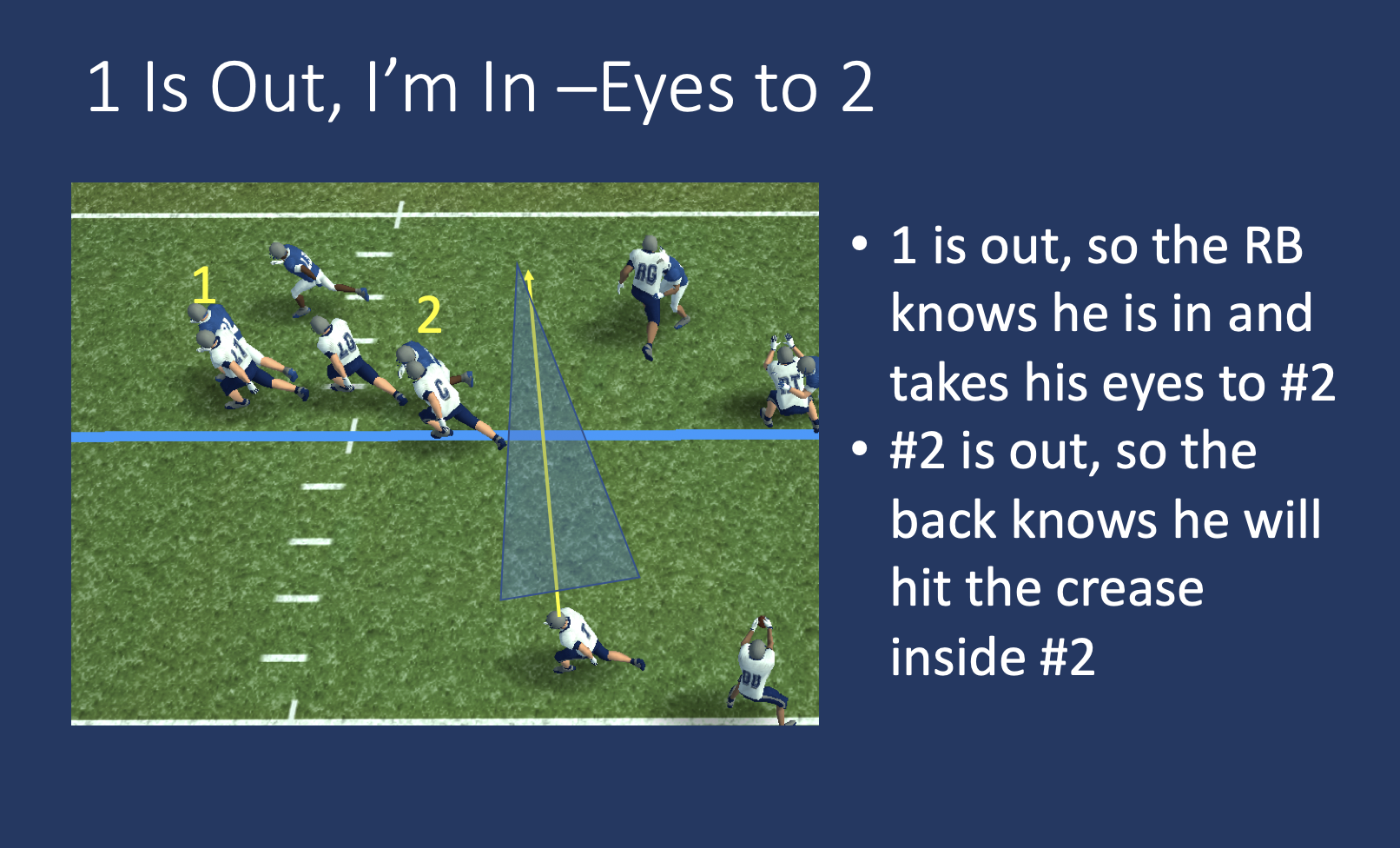
When #1 is out, the running back gets his eyes to #2. The back knows he doesn't have the edge, and #2 will show him where the vertical crease will be. If #2 is out, the back will go inside of #2. If #2 is in, the back will go outside of #2. 

The back sees #1 is out, so he takes his eyes to #2. He sees #2 is out, so he hits downhill inside #2. The flow of the defense has created a crease where the play hits downhill. The play is hitting in the A gap, but the A gap is where the C gap was located presnap. It looks like the play hit hard downhill, but that is because of the horizontal displacement of the defense. 

Below is a video clip illustrating #1 being out and #2 being out. 
You can see, this creates a crease to hit downhill. The defense is flowing to take away the perimeter, and they are giving the offense a crease inside. This all is predicated with creating flow. 

Below is another clip of #1 and #2 being out. 
And one more...
And another...

As you can see, the defense is flowing fast to take away the wide action. This creates seams for the running back. 

Let's look at the next read. If #1 is Out, and the back takes his eyes to #2 and sees #2 in, the back will hit between #1 and #2. This often happen against under front defenses when we can the 1 technique reached, and against odd defenses with a 0 nose guard. 
The figure above illustrates when #1 is out and #2 is in. This gives us a crease between #1 and
#2. 

Below is a video example of #1 being out and #2 being in. When #1 is out and #2 is in, the back hits downhill between 1 and 2. 
Here is another clip with 1 out and 2 in. This is from a trips look where we have the #3 receiver working inside to account for the playside inside backer. This is a wrinkle that is good from 3x1 sets where #3 is uncovered. 
Here is another clip of #1 being out and #2 being in. This time it is to a 3 man surface. 

You can see from the video above that the read for the back allows you to add versatility to the outside zone play. You stress the defense, and force them to slow down their ability to flow to the edge. Anytime you can make defenders play slower, you are going to have more explosive plays. 

Whether you are man or zone blocking, the back must be able to force the defense to defend the edge. Once he forces them to defend the edge, the back can use his vision to find the crease when the edge player widens to take away the perimeter. Teaching your young running backs to read 1 to 2 will help them be able to better find the crease, and will help you to be more successful running this concept. It also will give them more concrete and specific coaching than simply saying run to daylight. 

I wish you the best as you prepare for the upcoming season. If you are looking for some resources that will help you in your preparation, I have put together some things that coaches at all level of football are using with their programs. Not only will these help you be more organized, they will save you valuable time on the weekends. 

A few years ago I was speaking at a clinic about our game planning and an FBS coordinator asked me after the talk to go through what we do. I shared with him our offensive game planning resource and he used it through the spring. He emailed me back that it was a game changer. It was an honor to have him use these documents. After speaking at clinics and hearing that more coaches didn't know where to start, I decided to make these available.

Here is a link to my offensive game planning documents: https://sellfy.com/p/AndN/ 
It includes everything from a scouting report template, to practice plans, to a two-sided color call sheet, and more! Each of the nine documents are fully editable and customizable! Order today and start preparing for your first game right now! At one time this was $99, but it is available right now for less than $13!
Here are a couple of screen shots to show you what our call sheet looks like: 

This shows you a small portion of it. It is a fully editable, customizable two sided call sheet. It gives you the ability to better organize and be prepared on game day. It helped us to be better play callers on game day. There are eight other fully customizable documents! Some of the top high school programs in the country use this, as do several college programs!

When I was a defensive coordinator we adapted this to our defensive preparation! 
Here is a link to the defensive game planning documents. It includes 12 fully editable and customizable documents. https://sellfy.com/p/AY1u/ These are what we used to post 6 shutouts when I was a defensive coordinator. Defensive coordinators at all levels of football are using this. Again, it is less than $13 right now!

And finally, I put together a special teams resource. This has everything you need, included drill tape, practice tape, and game footage. It includes teaching presentations and scouting forms just for special teams! https://sellfy.com/p/tJwz/ This helped us to build dominating special teams! 

I wanted these to be available at a very reasonable cost. These can help you to be more successful on the field and more efficient in the office! 

 Last year I got hooked up with CoachTube, and put together three courses for offensive football coaches. I put together two courses on RPO's, and a course on Building An Elite System of Communication. All of these courses will help you to score more points! 

https://coachtube.com/users/coachvint


All three of these courses are detailed, with everything you need to be more explosive and to score more points. 

The course on communication gives you a detailed approach to your gameday communication. I give you a system and a process to improve the quality of conversations, leading to improved play calling on game day. This course has received outstanding reviews from coaches at all level of football. A coach with multiple state titles told me this course helped them to be much more efficient and explosive this season. 

My two RPO courses take you through a systematic process of installing RPO's into your offensive system. RPO's put the defense in conflict, forcing them to defend all 53 yards of width and all 6 skill players every single play. I not only give you a system, but I teach you the methods to develop your own RPO concepts. 

https://coachtube.com/users/coachvint

New Book

Over the last several months, I have stepped out of my comfort zone and wrote a new book about faith and purpose. The book is available as a paperback on Amazon, and as an eBook for the Kindle App. The cool thing about the Kindle app is that you can read the book on any device. I invite you to read it, and discover the power you receive when you make a decision to walk with the Lord. Here is a link to the book: Finding Faith

Since publishing the book, I have received numerous texts, calls, and emails, from people who are going through similar trials and tribulations. They were feeling many of the same things I was feeling. The found comfort in the book. They also found they had a desire to change and to live better. They wanted more joy. 

I would invite you to read the book and discover the possibilities that God has planned for your life. 


Thursday, December 17, 2020

Stepping Out of My Comfort Zone

This year I took a huge step to get out of my comfort zone. 2020 has been a really tough year. The world has faced adversity and loss, schools were closed, businesses were closed, and sports were shut down. People had financial loss, job loss, and loss of loved ones. To say it has been a tough year for most is an understatement. My own family faced huge adversity this year. But through adversity, we find opportunity. 

I realized that I had not been living right. I had lost my purpose. In the pursuit of wins on the football field, I lost who I was and why I coached. I began to examine who I was and who I wanted to be. I had become arrogant and self-centered. We were not having the success we had expected to have on the field, and I started to feel like I was a failure. Not only was I a failure on the field, but I was failing as a father and husband. 

My obsession with winning had made me lose focus on what really mattered. I decided it was time for change. It was time to change who I was. It was time to become the man I really wanted to be. I began to seek answers to the problems I was facing. Those of you who know me, know that I lived hard. I lived a lifestyle that I am not proud of. And worst of all, I led others down the wrong path. 

As I began to transform from who I was to who I wanted to be, I put my words on paper. The words ended up being a book on my search for purpose. Finding Faith was published the Sunday after Thanksgiving. 

What was missing in my life was having a faith in God. I had strayed so far from Him, that I didn't believe I was worthy of His love. I didn't believe I was worthy of the salvation we received from Jesus Christ dying on the cross. What I learned is that all of us are worthy of His love. All of us are worthy of salvation. While we may stray from God, He never strays from us. In fact, He does the opposite. He seeks us. He seeks our love. He wants us to build a relationship with Him? 

How do we build that relationship? First, we talk to Him through prayer. Praying is something I had done in times of need, but I had not prayed to form a relationship. I had to pray consistently, each day, regardless of circumstance. Second, I had to read the bible. I didn't know where to start reading, so I just started. I started with the writings of Paul. 

The apostle Paul had gone through his own transformation. He was once Saul of Tarsus, who persecuted Christians. Saul of Tarsus was on the road to Damascus with arrest warrants for Christians when he was knocked down by a bright light. That bright light was followed by a voice. It was the voice of Jesus asking Saul why he persecuted Him. He told Saul to go to Damascus where a man would meet Him. Saul then became Paul, who wrote much of the new testament. 

Paul's writings are very easy to read. They cover everything from how to live, to how to handle adversity, to how to follow Jesus. He gives instructions on how to become a man of God who loves Jesus Christ. Paul's writings reintroduced me to the amazing gift of salvation. Paul talked about having joy through adversity and trials. Adversity and trials produce endurance and perseverance. Adversity prepares us for something greater God has planned for us. And when we come through adversity, we can then help others through adversity they face. 

As I began to change my attitudes and behaviors, and put God first in my life, I started to live a life of joy. I began to realize that God has been working in my life this entire time, but I hadn't let myself form that powerful relationship. God has given me so many blessings, and looked upon me with favor. The problem was, I became arrogant. I thought every success was my doing. As I look back, I see the power of God, and how he provided the path. 

God has made each and every one of us perfectly. He has given us talents. He has given each of us a purpose. The talents he gave us fit perfectly to His purpose for our lives. He wants us to impact others, and to love others unconditionally. 

God gave me a teacher's heart. He put me here to make an impact. He gave me the ability to build relationships with people, and to get them to see the greatness they have inside. To use these gifts as He intended, I have to put Him first in my life. 


I now live with a three pronged purpose. I want to live a Godly life, where my life becomes a testimony for others to see God's power and love. Second, I want to be a Godly husband. Third, I aspire to be a Godly father. I want to be the spiritual leader of my family, showing them unconditional love. 

I don't know where you are in your life right now, but I will tell you that God has a purpose for your life. And that purpose is far beyond anything you can imagine. God created you for something very special. If you seek Him, He will reveal your purpose to you. 

When you choose to put God first, your problems will not go away. What you will learn, however,  is that many of our problems are actually blessings. The adversity we face isn't happening to us, it is happening for us. God is working in my life through every single event. Everything that is happening is for His purpose. 

Once I realized that, life changed. My attitude changed. My behaviors changed. I was a better father and husband. I was a better teacher and coach. I began to live with a joy that nothing in this world can break me. 

Sometimes we get to such a low point that we just feel broken. We feel like nothing we can ever do will make things right. There is one person who can pick up the pieces. That person is our Father in Heaven. He will put us back together, and he will put us back together so much better than we ever have been. 

In Finding Faith, I write about the steps I have taken to change my life. I talk about how to pray, how to read scripture, and how to make monumental change. I give you some tools you can use to live a life far beyond anything you have ever thought possible. I wrote the book to make an impact on others, and show them there is a better way. 

The book is available as a paperback on Amazon, and as an eBook for the Kindle App. The cool thing about the Kindle app is that you can read the book on any device. I invite you to read it, and discover the power you receive when you make a decision to walk with the Lord. Here is a link to the book: Finding Faith


Since publishing the book, I have received numerous texts, calls, and emails, from people who are going through similar trials and tribulations. They were feeling many of the same things I was feeling. The found comfort in the book. They also found they had a desire to change and to live better. They wanted more joy. 

I would invite you to read the book and discover the possibilities that God has planned for your life. 

Wednesday, November 25, 2020

Coach Tube Courses

 Last year I got hooked up with CoachTube, and put together three courses for offensive football coaches. I put together two courses on RPO's, and a course on Building An Elite System of Communication. All of these courses will help you to score more points! 

https://coachtube.com/users/coachvint


All three of these courses are detailed, with everything you need to be more explosive and to score more points. 

The course on communication gives you a detailed approach to your gameday communication. I give you a system and a process to improve the quality of conversations, leading to improved play calling on game day. This course has received outstanding reviews from coaches at all level of football. A coach with multiple state titles told me this course helped them to be much more efficient and explosive this season. 

My two RPO courses take you through a systematic process of installing RPO's into your offensive system. RPO's put the defense in conflict, forcing them to defend all 53 yards of width and all 6 skill players every single play. I not only give you a system, but I teach you the methods to develop your own RPO concepts. 

https://coachtube.com/users/coachvint