Many years ago I taught at a school that, like many schools, had a rule that kids couldn't wear hats in the building. My first day I noticed a lot of kids wearing hats. I told them to take off their hats. They all complied, but not without disdain for my request. Usually they would get out of sight and put their hat back on. The reason was simple... If you have a rule or standard that is not consistently enforced, the standard will not be met. It is that simple. It was very, very frustrating. The standard was that
no students were to wear hats. That is very clear. The problem lied in the fact that there was no accountability. A few teachers enforced the rule, but most ignored it. The reason they ignored it is because there was no follow through from the leadership. If you aren't going to enforce the rule or standard at all levels, then get rid of the rule.
I tell you this because this happens in many athletic programs, schools, and companies throughout the globe. Leaders set rules or standards and then don't hold people accountable. Or, they hold them accountable selectively. They don't coach them on the details. They tell them to stand a certain way, and then permit them to deviate. They tell them to wear certain clothing, and allow them to deviate. They tell them to be there at a certain time, and when someone is late, there is not accountability. Permitting is promoting. When you allow it to happen you might as well be asking for it to happen. If you allow one to do it, another will. If you allow it once, then it will happen twice. Then three times. After a few weeks, a coach will have a bad day and go off on their athletes for not meeting the standard that has never or rarely been enforced. The kids aren't the problem. The coaches are.
"If they don't know the standard, how can they possibly reach or exceed the standard?"
This is not a great way to build trust. It is not a way to build discipline. It is a great way to lose your athletes and drive a wedge between you and them. Before you get angry, ask yourself, "why are my athletes not meeting the standard?" It is one of two things.
First, your standards are not clearly laid out. Your athletes don't understand what you are asking for. You are not coaching the details. The
second reason is that you have permitted them to deviate from the standard. If you let them deviate from one thing, you need to expect them to deviate from everything.
This is where programs start to have issues with discipline. If you are having issues with discipline, ask yourself the following three questions:
1. Are our standards clearly laid out AND understood? It is not enough to teach them, you have to make sure the standards have been learned. You constantly have to reinforce the standard. Ask your athletes to repeat the standard to you. Ask them to show you the standard. They can't meet a standard they don't understand. They also can't hit a moving target. If the standard is always moving they will never be able to hit it. You have to have clear set of verbiage for the standard. It has to be the same every time. If the standard is not consistently taught, it will not be clearly understood.
2. Have I permitted deviation fromt the standard? If you permitted deviation from one standard, expect deviation from other standards. If you tell them they all have to have a white t-shirt, and everyday athletes are missing the white t-shirt and you ignore it, expect a lack of discipline. How will they take your standard seriously? This is dangerous. If you don't hold the standard on the white shirt, how can you expect them to line up right on Friday night? How can you expect them to take a six inch step on your zone play? If they are allowed to deviate from the white t-shirt, they will believe they can deviate from other standards as well.
3. Are WE consistently holding people accountable to the standard? Is every coach holding your athletes to the standard, or does each coach have a different set of standards? There is nothing more frustrating as an assistant coach than holding someone accountable and feeling like you are on an island. It goes right back to the issue with hats in school. If the standard changes from coach to coach, athletes will lose trust and confidence in you and the staff. The standard must be consistent from coach to coach. If one coach has one standard on parallel squat and another coach has a different standard, there will be confusion.
If the answer to any or all of these questions sound familiar, chances are you are pretty frustrated. Whether you are the coach permitting, or you are the lone ranger holding people accountable, you are probably having moments of frustration. Your culture is probably suffering. If your culture is suffering, you will never play as well as you think you can. You will lose to people even when you have more talent. You will be inconsistent. Your players will question and lay blame when things don't go well. They will not trust you or what you are doing.
Why does this matter? Why do we even bother? The reason is simple. Great programs have clearly defined expectations that are consistently upheld. They hold athletes accountable for not meeting the standard and constantly reteach and coach them on how to meet the standard. They try to meet the athlete at their level and bring them to the standard. They are willing to confront even when it might be uncomfortable. Because you are willing to confront deviations from the standard, the standard will be met. Your players will understand that if they do not meet the standard they will be corrected. Correction is love, and consistent correction builds discipline.
If you are struggling with this, the great news is:
you can change. But the only way it will change is with action. You have to reset the situation. Set very clearly defined standards of performance. Make sure all of your coaches understand the standards, and explain them to your team. Then, hold them accountable to the standard, every single day. A reset is simply an opportunity to tell your team or organization that you did not hold them to their highest standard, and that will change. It will not be easy. There will be some pain. But the results will be worth the investment.
Several years ago we had to do this. We worked very hard to build a championship culture. We had a couple of very good seasons and we had a strong nucleus returning. We made the mistake of letting them slip on our standards. We did not hold them to a standard of excellence. We let them slide on little details. We thought, well, we are good enough to overcome these things. The problem is, the little things got bigger each day. One afternoon in April we noticed several guys straggling into the weight room late. A couple of these guys were our captains. During our workout we had another group of guys cutting sets. I went ballistic. I let them know this was absolutely the opposite of what we wanted. This was not meeting our standard. While I got my frustration out, nothing changed. The next day we had the same issues. We looked entitled and refused to work hard. They weren't getting deep enough on squat. They weren't locking out their bench. They weren't finishing when things got tough.
We pulled a few of the guys in and asked them why they were deviating from the standard. Their answers shocked us. "Because no one said anything." That said a lot right there. I thought, "we shouldn't have to." But I stopped myself from saying it. That's because WE NEED TO SAY SOMETHING! It's our job. It is just like when guys say, "we are not going to coach you on effort." Then don't expect great effort! You have to coach everything all the time. There is no other way to be successful.
As a coaching staff we made a decision to do a reset. The next day we brought them in and told them we failed to hold them accountable to our standards, and that would change immediately. We reset the whole deal. We retaught the standards. We told them why we were doing this, and that we would never again fail to hold them accountable to reaching our standards. Everything was redefined.
The reset was a defining point in that season. It was vital for our preparation to confront the problem and change. Without the reset we would have been mediocre at best. We would not have been successful as a program. Our players learned a valuable lesson and so did our coaching staff. You are entitled to nothing. When you build your culture and get things going the way you want them to go, you cannot coast. You can never relax. If you do find yourself slipping and standards not being met, immediately confront the issue.
Leadership requires confrontation. There is no other way. You can't ignore deviations from the standard and expect them to improve. And the confrontation does not need to be ugly. You can confront without building resentment. You can confront without trampling on someone's dignity.
Here is a simple 4 step process for accountability:
1. Confront
2. Clarify
3. Reteach
4. Evaluate
Confront- If the standard is not being met immediately stop the person and tell them they are not performing to the standard
Clarify- Make sure they clearly understand what is expected. Have them repeat the standard back to you.
Reteach- Demonstrate the standard. Make sure they can perform the standard whether you are looking or not.
Evaluate- Make sure they are performing to our expectations
It is up to everyone to enforce the standards. If it is important to you, find a way. If not, you will certainly find an excuse. Everyone must be invested in our standards. And if you aren't willing to enforce a standard, eliminate it. It will only lead to deviation from more important standards.
Every single day you are building a culture within your program. Are you building your culture by design or by chance? The biggest part of building culture is to set high standards and to have everyone in your organization enforce the standards.
Shameless plug of my Interactive iBooks!
Early this year I wrote a book RPO's and a book on Tempo. I want these books to be accessible without worrying about $$$. They are available as an apple iBook and on Amazon. The iBook version contains embedded video! These two books will revolutionize your offense!
In my RPO book I describe in detail a systematic process to install RPO's. I go over first level, second level, third level, and multi-level reads. I show you how to scaffold the install and build a system that will fit what you are already doing.
Here is a picture of the cover with some quotes from other coaches on the book:
If you have an iPad or iPhone, buy the ibooks version! If you have an android or PC based device, I have a Kindle version for sale on Amazon. Here is a link to that version:
Kindle Version of Coach Vint's RPO Book on Amazon. The kindle version has everything but the video.
The other part of this equation is adding Tempo. A lot of coaches ask me to help them install different elements of tempo into their offense. The book I wrote will take you through a detailed, systematic process of building tempo into your existing offense. Here is a picture of what coaches are saying:
The iBook version for the iPad, iPhone, and Mac contains over an hour of embedded video! I give you a systematic process to build tempo into your offense. I show you multiple ways to communicate your concepts, including sign boards! Here is a link to the iBooks version:
http://itunes.apple.com/us/book/id1075902270
Combining Tempo with RPO concepts will change the game of football for generations. Any offensive system can adapt these principles without changing the structure of you offense. The biggest issue many schools face is simply thinking they can only use RPO's part of the time. You never have to call a run again that isn't protected by a pass concept.
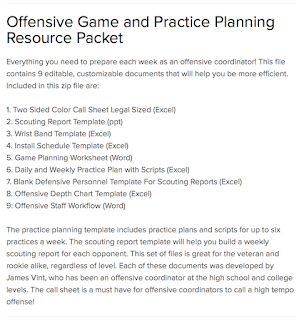
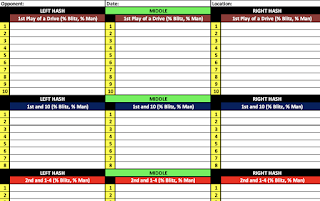
One of the keys to our success was tremendous preparation!The key to preparation was our outstanding group of documents we used for all three phases. If you are looking for fully editable and customizable documents that you can tailor to your program, I have made mine available.
It includes everything from a scouting report template, to practice plans, to a two-sided color call sheet, and more! Each of the nine documents are fully editable and customizable! Order today for under $15 and download them tonight!
Here is a link to the defensive game planning documents. It includes 12 fully editable and customizable documents.
https://sellfy.com/p/AY1u/
And finally, I put together a special teams resource. This has everything you need, included drill tape, practice tape, and game footage. It includes teaching presentations and scouting forms just for special teams!
https://sellfy.com/p/tJwz/
I hope you have found something of value in this post! I wish you the best as you prepare for your season!